Hello World

吞风吻雨葬落日 欺山赶海踏雪径

0%

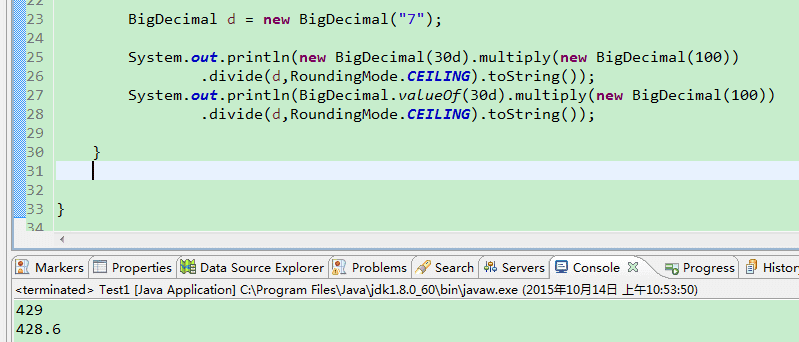
Java的BigDecimal精度

一道面试题

new BigDecimal(30d)

1
2
3
4
5
6
7
8
9
10
11
12
13
14
15
16
17
18
19
20
21
22
23
24
25
26
27
28
29
30
31
32
33
34
35
36
37
38
39
40
41
42
43
44
45
46
47
48
49
50
51
52
53
54
55
56
57
58
59
60
61
62
63
64
65
66
67
68
69
70
71
72
73
74
75
76
77
78
79
80
81
82
83
84
85
public BigDecimal(double val) {
this(val,MathContext.UNLIMITED);
}

public BigDecimal(double val, MathContext mc) {
if (Double.isInfinite(val) || Double.isNaN(val))
throw new NumberFormatException("Infinite or NaN");
// Translate the double into sign, exponent and significand, according
// to the formulae in JLS, Section 20.10.22.
long valBits = Double.doubleToLongBits(val);
int sign = ((valBits >> 63) == 0 ? 1 : -1);
int exponent = (int) ((valBits >> 52) & 0x7ffL);
long significand = (exponent == 0
? (valBits & ((1L << 52) - 1)) << 1
: (valBits & ((1L << 52) - 1)) | (1L << 52));
exponent -= 1075;
// At this point, val == sign * significand * 2**exponent.

/*
* Special case zero to supress nonterminating normalization and bogus
* scale calculation.
*/
if (significand == 0) {
this.intVal = BigInteger.ZERO;
this.scale = 0;
this.intCompact = 0;
this.precision = 1;
return;
}
// Normalize
while ((significand & 1) == 0) { // i.e., significand is even
significand >>= 1;
exponent++;
}
int scale = 0;
// Calculate intVal and scale
BigInteger intVal;
long compactVal = sign * significand;
if (exponent == 0) {
intVal = (compactVal == INFLATED) ? INFLATED_BIGINT : null;
} else {
if (exponent < 0) {
intVal = BigInteger.valueOf(5).pow(-exponent).multiply(compactVal);
scale = -exponent;
} else { // (exponent > 0)
intVal = BigInteger.valueOf(2).pow(exponent).multiply(compactVal);
}
compactVal = compactValFor(intVal);
}
int prec = 0;
int mcp = mc.precision;
if (mcp > 0) { // do rounding
int mode = mc.roundingMode.oldMode;
int drop;
if (compactVal == INFLATED) {
prec = bigDigitLength(intVal);
drop = prec - mcp;
while (drop > 0) {
scale = checkScaleNonZero((long) scale - drop);
intVal = divideAndRoundByTenPow(intVal, drop, mode);
compactVal = compactValFor(intVal);
if (compactVal != INFLATED) {
break;
}
prec = bigDigitLength(intVal);
drop = prec - mcp;
}
}
if (compactVal != INFLATED) {
prec = longDigitLength(compactVal);
drop = prec - mcp;
while (drop > 0) {
scale = checkScaleNonZero((long) scale - drop);
compactVal = divideAndRound(compactVal, LONG_TEN_POWERS_TABLE[drop], mc.roundingMode.oldMode);
prec = longDigitLength(compactVal);
drop = prec - mcp;
}
intVal = null;
}
}
this.intVal = intVal;
this.intCompact = compactVal;
this.scale = scale;
this.precision = prec;
}

BigDecimal.valueOf(30d)

1
2
3
4
5
6
7
8
9
10
11
12
13
14
15
16
17
18
19
20
21
22
23
24
25
26
27
28
29
30
31
32
33
34
35
36
37
38
39
40
41
42
43
44
45
46
47
48
49
50
51
52
53
54
55
56
57
58
59
60
61
62
63
64
65
66
67
68
69
70
71
72
73
74
75
76
77
78
79
80
81
82
83
84
85
86
87
88
89
90
91
92
93
94
95
96
97
98
99
100
101
102
103
104
105
106
107
108
109
110
111
112
113
114
115
116
117
118
119
120
121
122
123
124
125
126
127
128
129
130
131
132
133
134
135
136
137
138
139
140
141
142
143
144
145
146
147
148
149
150
151
152
153
154
155
156
157
158
159
160
161
162
163
164
165
166
167
168
169
170
171
172
173
174
175
176
177
178
179
180
181
182
183
184
185
186
187
188
189
190
191
192
193
194
195
196
197
198
199
200
201
202
203
204
205
206
207
208
209
210
public static BigDecimal valueOf(double val) {
// Reminder: a zero double returns '0.0', so we cannot fastpath
// to use the constant ZERO. This might be important enough to
// justify a factory approach, a cache, or a few private
// constants, later.
return new BigDecimal(Double.toString(val));
}
public BigDecimal(String val) {
this(val.toCharArray(), 0, val.length());
}
public BigDecimal(char[] in, int offset, int len) {
this(in,offset,len,MathContext.UNLIMITED);
}

public BigDecimal(char[] in, int offset, int len, MathContext mc) {
// protect against huge length.
if (offset + len > in.length || offset < 0)
throw new NumberFormatException("Bad offset or len arguments for char[] input.");
// This is the primary string to BigDecimal constructor; all
// incoming strings end up here; it uses explicit (inline)
// parsing for speed and generates at most one intermediate
// (temporary) object (a char[] array) for non-compact case.

// Use locals for all fields values until completion
int prec = 0; // record precision value
int scl = 0; // record scale value
long rs = 0; // the compact value in long
BigInteger rb = null; // the inflated value in BigInteger
// use array bounds checking to handle too-long, len == 0,
// bad offset, etc.
try {
// handle the sign
boolean isneg = false; // assume positive
if (in[offset] == '-') {
isneg = true; // leading minus means negative
offset++;
len--;
} else if (in[offset] == '+') { // leading + allowed
offset++;
len--;
}

// should now be at numeric part of the significand
boolean dot = false; // true when there is a '.'
long exp = 0; // exponent
char c; // current character
boolean isCompact = (len <= MAX_COMPACT_DIGITS);
// integer significand array & idx is the index to it. The array
// is ONLY used when we can't use a compact representation.
int idx = 0;
if (isCompact) {
// First compact case, we need not to preserve the character
// and we can just compute the value in place.
for (; len > 0; offset++, len--) {
c = in[offset];
if ((c == '0')) { // have zero
if (prec == 0)
prec = 1;
else if (rs != 0) {
rs *= 10;
++prec;
} // else digit is a redundant leading zero
if (dot)
++scl;
} else if ((c >= '1' && c <= '9')) { // have digit
int digit = c - '0';
if (prec != 1 || rs != 0)
++prec; // prec unchanged if preceded by 0s
rs = rs * 10 + digit;
if (dot)
++scl;
} else if (c == '.') { // have dot
// have dot
if (dot) // two dots
throw new NumberFormatException();
dot = true;
} else if (Character.isDigit(c)) { // slow path
int digit = Character.digit(c, 10);
if (digit == 0) {
if (prec == 0)
prec = 1;
else if (rs != 0) {
rs *= 10;
++prec;
} // else digit is a redundant leading zero
} else {
if (prec != 1 || rs != 0)
++prec; // prec unchanged if preceded by 0s
rs = rs * 10 + digit;
}
if (dot)
++scl;
} else if ((c == 'e') || (c == 'E')) {
exp = parseExp(in, offset, len);
// Next test is required for backwards compatibility
if ((int) exp != exp) // overflow
throw new NumberFormatException();
break; // [saves a test]
} else {
throw new NumberFormatException();
}
}
if (prec == 0) // no digits found
throw new NumberFormatException();
// Adjust scale if exp is not zero.
if (exp != 0) { // had significant exponent
scl = adjustScale(scl, exp);
}
rs = isneg ? -rs : rs;
int mcp = mc.precision;
int drop = prec - mcp; // prec has range [1, MAX_INT], mcp has range [0, MAX_INT];
// therefore, this subtract cannot overflow
if (mcp > 0 && drop > 0) { // do rounding
while (drop > 0) {
scl = checkScaleNonZero((long) scl - drop);
rs = divideAndRound(rs, LONG_TEN_POWERS_TABLE[drop], mc.roundingMode.oldMode);
prec = longDigitLength(rs);
drop = prec - mcp;
}
}
} else {
char coeff[] = new char[len];
for (; len > 0; offset++, len--) {
c = in[offset];
// have digit
if ((c >= '0' && c <= '9') || Character.isDigit(c)) {
// First compact case, we need not to preserve the character
// and we can just compute the value in place.
if (c == '0' || Character.digit(c, 10) == 0) {
if (prec == 0) {
coeff[idx] = c;
prec = 1;
} else if (idx != 0) {
coeff[idx++] = c;
++prec;
} // else c must be a redundant leading zero
} else {
if (prec != 1 || idx != 0)
++prec; // prec unchanged if preceded by 0s
coeff[idx++] = c;
}
if (dot)
++scl;
continue;
}
// have dot
if (c == '.') {
// have dot
if (dot) // two dots
throw new NumberFormatException();
dot = true;
continue;
}
// exponent expected
if ((c != 'e') && (c != 'E'))
throw new NumberFormatException();
exp = parseExp(in, offset, len);
// Next test is required for backwards compatibility
if ((int) exp != exp) // overflow
throw new NumberFormatException();
break; // [saves a test]
}
// here when no characters left
if (prec == 0) // no digits found
throw new NumberFormatException();
// Adjust scale if exp is not zero.
if (exp != 0) { // had significant exponent
scl = adjustScale(scl, exp);
}
// Remove leading zeros from precision (digits count)
rb = new BigInteger(coeff, isneg ? -1 : 1, prec);
rs = compactValFor(rb);
int mcp = mc.precision;
if (mcp > 0 && (prec > mcp)) {
if (rs == INFLATED) {
int drop = prec - mcp;
while (drop > 0) {
scl = checkScaleNonZero((long) scl - drop);
rb = divideAndRoundByTenPow(rb, drop, mc.roundingMode.oldMode);
rs = compactValFor(rb);
if (rs != INFLATED) {
prec = longDigitLength(rs);
break;
}
prec = bigDigitLength(rb);
drop = prec - mcp;
}
}
if (rs != INFLATED) {
int drop = prec - mcp;
while (drop > 0) {
scl = checkScaleNonZero((long) scl - drop);
rs = divideAndRound(rs, LONG_TEN_POWERS_TABLE[drop], mc.roundingMode.oldMode);
prec = longDigitLength(rs);
drop = prec - mcp;
}
rb = null;
}
}
}
} catch (ArrayIndexOutOfBoundsException e) {
throw new NumberFormatException();
} catch (NegativeArraySizeException e) {
throw new NumberFormatException();
}
this.scale = scl;
this.precision = prec;
this.intCompact = rs;
this.intVal = rb;
}

底层竟然用了不同的方法初始化Bigdedecimal。其实只是Double.toString(val)改变了精度。建议是增加上精度的参数。